

Overview
Before receiving nomination documents from the Elections Department, you must file a completed Candidate Application Form, either in person or through our website. If you use our website, you will receive an email with instructions and additional information.
The application is only used to verify the status of your voter registration and residence address. The information you provide on the application is not made public but must match our records.
On the application we ask for a contact email address and phone number for internal use only. A business email is fine so long as you can respond daily. In addition you may choose a way for the media and general public to contact you.
Elected officials and candidate’s personal information will be confidential when producing any list or report, except for journalistic or governmental purposes under specified conditions. This is automatic though you may opt out confidential status.
Your candidate documents will include the Opt-Out form. If this form is not signed and submitted by the candidate, confidential status will be applied.
Below is a list of the forms that may or may not be required or optional, depending on your contest. Descriptions of each are on the following pages.
Candidate Documents
The Declaration of Candidacy form must be completed in the office of the elections official, or signed and witnessed by a registered notary public and filed in the office of the election official with all other required documents by the end of the nomination period. If using an out-of-state notary, a notarial certificate must be included. (Elec. Code § 8040(c))
A candidate may authorize in writing to have a person receive and deliver the Declaration of Candidacy. The candidate must indicate that he or she is aware the Declaration must be properly executed and filed with the election official by the end of the nomination period.
Candidates may not file a Declaration of Candidacy form for more than one term of office for the same district, or for more than one district or municipal office at a time. (E.C. §8003(b), §10510(b), §10220.5)
How do you want your name to appear on the ballot?
Indicate your name preference on the Declaration of Candidacy form.
The name you choose on the Declaration of Candidacy form is the only name that shall be on the ballot and must be written on other candidate papers. (A.G. Ops 50-87, 5/27/80)
You can keep your voter registration name, or you may designate your name as follows:
- You can use your nickname in quotation marks, along with your legal name on your form. You may also use a first name that you are known by in your community. Either choice must include your registered last name.
- First, middle, and last name.
- Initials only with your last name.
- A familiar or common version of the first name such as Bill for William or Becky for Rebecca, etc.
Please note, you cannot have titles or degrees with your name on the ballot. (EC §13106)
Ballot Designation
The optional Ballot Designation is located under your name on the ballot. If you choose to have a ballot designation, you must indicate this on the Declaration of Candidacy form. If you choose not to have a designation, write “NONE” on your Declaration of Candidacy form and write your initials after the word “NONE.”
In order to have a ballot designation you must complete and file a Ballot Designation Worksheet with your Declaration by the deadline. The first designation you choose to write on the worksheet must be written on your Declaration of Candidacy.
The Ballot Designation refers to your current occupation, vocation, profession, or incumbency status. You may list more than one profession, occupation, or vocation, but you must separate them with a slash, e.g., Professor/Mother/Doctor.
Most candidates are limited to three words. However, an elected official may use the exact title of the office currently held, e.g., Director, ABC Fire Protection District.
Note: If you choose titles or words that are long they may be printed in a smaller font size.
California state law requires that your designation describes your current occupation, profession, vocation, or what you did for a living during the 12 months before the filing deadline. The words you choose must be specific and accurate, and must not mislead voters. (Elec. Code § 13107; 2 CCR § 20716)
Request for supporting documents
Candidates are responsible for providing thorough and accurate information. If the information requires additional clarification the Elections Department or Secretary of State may request supporting documentation or evidence supporting your proposed ballot designation. (2 CCR § 20717)
Rules for specific types of ballot designations and candidates
Primary election candidates
Your ballot designation will be the same for both primary and general elections (if applicable), unless at least 98 days before the general election, you request in writing a different designation which you are entitled to use at the time of the request.
If you are an incumbent…
- Your elected title, even if the title has more than 3 words.
- Your elected position and your other occupation or vocation if using 3 words or less. Example: Board Member/Teacher
- The word Incumbent (no other words allowed) if you are filing for the same office you hold now.
- Only local candidates do not have to justify the use of the word incumbent or appointed incumbent. You may simply write “current officeholder” in the justification sections or leave it blank. The election staff will stamp as confirmed.
If you are an appointed incumbent…
- The words Appointed Incumbent (no other words allowed) if you are running for the same office you hold now. Judicial candidates appointed to a judicial seat are not required to use this designation and can use Incumbent instead. (Elections Code § 13107(B)(1)(b))
- The word Appointed along with your current elected position and the jurisdiction (Appointed Board Member, ABC School District), or the word Appointed along with your current elected position and another designation (Appointed Trustee/Mother).
If you are a non-incumbent judicial candidate and an active member of the State Bar, you must use any of the following:
- “Attorney,” “Attorney at Law,” “Lawyer,” or “Counselor at Law”.
- Words designating the actual job title if employed by the city, county, district, state, or federal office held by the candidate at the time of filing and must contain relevant qualifiers such as “City of...”, “County of...”, or the full name of the governmental agency.
- If your designation describes your position in performing quasi-judicial functions for a governmental agency, the full name of that agency must be included.
- The designations “Attorney” and “Lawyer” may be used in combination with one other designation held currently or within the previous calendar year (Attorney/Website Developer).
You may use the words community volunteer if:
2 CCR § 20714.5)
- You are substantially involved as a community volunteer with bona fide organizations;
- You do not have another principal occupation or vocation; and
- You do not add any other words to describe another occupation or vocation.
You may use the word retired if:
(Elec. Code § 13107; 2 CCR § 20716(h))
- You are 55 or older, and worked at your last job or vocation for more than 5 years and left voluntarily;
- A principal source of your income is from a retirement plan or retirement benefits (or you are eligible to receive retirement benefits).
- You cannot use retired if you have had more recent professions, occupations, or vocations; and you cannot abbreviate the word Retired.
Rejection of ballot designations
Each designation is evaluated based on guidelines and restrictions stated in the Elections Code. Designations will be determined given a candidate’s individual circumstance.
The Secretary of State’s office administers rules and procedures for State and Federal candidates. The worksheet must be fully completed, otherwise it will be rejected and returned by the State.
Candidates are given an opportunity to make a correction. If you do not provide an acceptable alternative designation by the deadline, no ballot designation will be listed after your name.
The following provides a partial list of designations deemed generally not acceptable.
| Do not use words that… | Examples |
|---|---|
| Evaluate | outstanding, leading, expert, virtuous, eminent, best, exalted, prominent, activist, reformer, pro, anti |
| Suggest status but not your occupation |
taxpayer, patriot, citizen, renter, presidential appointee, husband, wife, scholar, veteran, concerned citizen, activist |
| Suggest a religious or ethnic group | Asian, Christian, Irish |
| Suggest a political party or ideology | Conservative, Democrat, Republican, Socialist, Absolutism, Anarchist |
| Pro Forma positions or vocations | honorary, hostess, goodwill ambassador (see CA Admin. Code 20716) |
| Suggest previous occupations | former, ex-, past- You may be able to use retired. |
| Name of a company, agency, or person |
Instead of: IBM President, use: Computer Corporation President Instead of: Director, DMV, use: State Agency Director |
| Mislead | An occasional activity, hobby, or position that takes up little of your time. You may have to give proof to support the accuracy of your designation. |
Rejection Exceptions
There may be exceptions to the rejection of a designation. Certain designations may be considered depending on the circumstance of each candidate, even if it does not describe a significant involvement on the part of the candidate. Exceptions must be approved by the election official.
You have the option to file a 200-word candidate statement to be printed in the Marin County Voter Information Guide. Congressional & State Assembly candidates are allowed 250 words.
- File your statement no later than 5 p.m., March 6, 2026. If you are filing for office during an extended nomination period, the deadline is 5 p.m., March 11, 2026.
- Our office requires a check as payment for your statement, and it is required when filing your nomination documents.
- If applicable to your candidacy you have the option to print your statement in multiple counties. Each county will charge separately and must receive payment directly from you. Please contact those county elections officials for costs and applicable forms.
- Review your statement carefully and/or proofread with another person because you are not allowed to correct typos or mistakes after the close of the filing period.
- If you choose to withdraw your statement you must do so by the close of business of the next working day after the close of the nomination period. Your check will be returned to you by mail or you may come to our office.
- Candidate statements must be submitted in electronic version, preferably in Word. Candidates filing a handwritten statement will be charged an additional $150 fee.
- The amount charged for your statement is an estimate of the actual costs that may vary between elections depending on several factors such as the number of registered voters in that jurisdiction, and the costs of printing and mailing.
Candidate Statement Fees
Candidates must pay a fee to have their statement printed in the Marin County Voter Information Guide. If you wish to have your statement printed in Spanish your cost is doubled plus a translation fee. We do not accept credit cards, only cash or check.
Fee estimates start with the total number of registered voters from the last report filed with the State prior to the end of the applicable nomination period. The final cost for your statement is affected by processing, printing, and mailing expenses, and by the total number of registered voters allowed to vote in your jurisdiction through election day. As previously mentioned, if your word count exceeds the size of the quarter page box, you will be charged for each additional quarter page box your statement uses.
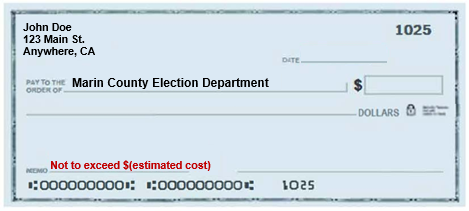
You must provide a blank check made payable to the Marin County Elections Department. On the memo line of your check, write “not to exceed" and the amount provided by the elections official. The following page shows a sample of how your check should look.
Your check will not be cashed until after election certification when costs have been finalized. Please be sure to plan for this.
The chart below is an estimate of candidate statement costs per voter totals. For example contests with more than 180,000 registered voters is estimated to cost no less than $1,725 for one quarter page. When you are ready to deliver your check, the elections official will confirm the number of registered voters for your contest and provide the not to exceed amount to write on your check.
| Number of Registered Voters After the Election… |
One Quarter Page | Two Quarter Page (add $100 for Spanish translation) |
|---|---|---|
| No Less Than 180,000 | $1,725 | $3,550 |
| No Less Than 170,000 | $1,640 | $3,380 |
| No Less Than 87,000 | $925 | $1,850 |
| No Less Than 40,000 | $515 | $1,030 |
| No Less Than 30,000 | $430 | $960 |
| No Less Than 20,000 | $350 | $800 |
| No Less Than 10,000 | $260 | $720 |
| No Less Than 8,000 | $240 | $580 |
| No Less Than 5,000 | $215 | $530 |
| No Less Than 1,000 | $180 | $460 |
Reference for Not To Exceed amounts. Actual costs are determined after the election is certified.
State Voluntary Expenditure Limits
State Senate and State Assembly candidates accepting the State’s voluntary expenditure limits listed below may purchase space in our Voter Information Guide. Candidates must complete and file the Form 501 (Candidate Statement of Intention) with the Secretary of State. (Gov’t. Code § 85601)
2026 General Election
- $1,373,000 State Assembly candidates
- $1,765,000 State Senate candidates
Sample of Candidate Statement Check:
- Candidates must provide a blank check made payable to the Marin County Elections Department.
- Write Not to Exceed $(estimated cost) in the memo space of the check.
- The Elections Department will determine the final amount after determining all associated costs.
Content requirements
Your candidate statement may include information about your education, experience, and other qualifications, and shall not include information about your party affiliations, memberships, or activities in any political party organizations. Listing memberships to or affiliations with organizations that are found to have distinct political inclinations may not be accepted. (Elec. Code § 13307(a))
You shall not directly or indirectly reference any other candidate, nor suggest or imply the qualification of other candidates by stating “I am the only candidate…”, or any other similar wording. (Elec. Code § 13308) If your statement does not comply, the election official will require changes.
Endorsements by individuals and organizations are allowed but must be verified by written authorization (email is acceptable) directly from the endorsers. The endorsement must include the candidate’s name, the elective office, the date of the election, and the name of the endorser.
The use of a non-endorsing individual or an organization’s name in a statement is only allowed if being used exclusively as biographical information.
Formatting requirements
All candidate statements must be uniform in type and size, and single-spaced lines.
- No ALL CAPS (use upper and lower case).
- No italics, no bold, no underlining, and no highlighting.
- No clusters of exclamation points!!!!
- No bullets or numbered lists (we will replace them with semicolons and wrap text).
- Em and En dashes may or may not be allowed, and it may add one extra word to your count. See the following page for details.
- Indents are allowed.
- 200 words maximum based on rules specified in Elections Code §9.
- Word count begins after “Education and Qualifications” on a Candidate Statement.
Your name must match your name on the ballot. Variations are not allowed. Age and Occupation are optional.
Occupation must be truthful, and may refer to your current employment or vocation, or status as an active licensed professional even if not currently employed as such.
Unlike the ballot designation, you may use the word former or retired even if you do not receive a pension or if this was not your last profession or employment.
Your statement must fit in a quarter-page section (example shown below is not to scale).
If your statement extends beyond that, you are effectively using a second quarter-page, and you will be charged for both sections.
Sample Format
STATEMENT OF CANDIDATE
MEMBER, CITY COUNCIL
Greatest City
JANE CITIZEN AGE: 35
Occupation: Manager, Parent, Writer
Education and Qualifications:
I can bring to the office a diversity of viewpoints and experience. Born and raised in the San Francisco area, with my family still farming, I can appreciate the concerns of the environmentalists.
With my experience in the rental and real estate field, I appreciate the practical housing choices and frustrations with high rental cost.
I advocate a program to protect our neighborhoods from increasing overcrowding and visual blight. As a Member of the City Council, I would bring balanced points of view.
I am endorsed by Dr. Fig Newton, the Council of Likable Folks, and the Association of Amazing Shovels.
I humbly ask for your vote.
Jane Citizen
www.jccandidate.com
Word Counting Guide
(Elections Code §9)
The examples below are to help guide you when creating your candidate statement, ballot measure text, measure argument and rebuttal, all of which require limited number of words.
You will be asked to delete or change text until it conforms with those requirements.
The examples are not applicable to a candidate’s ballot designation.
Symbols:
Such as “#” when used in place of a word or number will be counted as one word.
Proper Nouns:
All definable proper nouns will be counted as one word.
Examples: John Smith, Marin County Elections Department, Ford F150
Geographical Names:
All geographical names, including areas of governed political boundaries are counted as one word.
Examples: Tamalpais Union High School District, Marin County, State of California
Abbreviations & acronyms:
Abbreviations and acronyms, such as Dist., UCLA, U.S.M.C., FYI, PTA, count as one word.
Hyphenated words:
Hyphenated words that appear in any generally available standard reference dictionary at any time within the 10 calendar years immediately preceding the current election.
Examples: Fifty-five, ex-president, attorney-at-law, well-known
Dates:
All dates, regardless of letter or number combination, will be counted as one word.
Examples: 11/4/24, or November 4, 2024
Numbers:
A number consisting of digit(s) will be counted as one word, for example 100, or 2,587.
A number that is spelled out may be counted as:
One word: thousand
Two words: one hundred
Three words: two hundred seventy-four
Contact Information:
Telephone numbers, email addresses, and website addresses will be counted as one word.
Example: smithABC123.net
Punctuations are NOT counted!
Em and En dashes:
Your program’s word count will not separate the words being connected.
In the Em dash example ‘granddaughters—Debbie and Lisa’, your program counts 3 words. Our office may count this as 5 words because the Em dash uses an extra space. If appropriate, please consider using a comma instead.
In the En dash examples 1998-2003, or Dallas-Miami, each will be counted as 2 words because it designates a range of relevant information.
The Political Reform Act requires candidates and officeholders to publicly disclose their personal assets and income from the previous calendar year and disqualify themselves from participating in decisions that may affect their economic interests. The Form 700 is a public document and will be posted on the County and/or State website, depending on the contest.
The Form 700 and reference pamphlet are included with your candidate papers, each with detailed instructions and information. You must complete and file the Form 700 with your other candidate documents, or no later than the close of the nomination period.
Candidates filing for the following contests must e-file with the Fair Political Practices Commission:
State Assembly
State Senate
County Supervisor
City Councilmembers
When your candidate documents are issued, you will be entered into the FPPC’s program and you will receive an email with instructions how to login and file the Form 700.
The basics you need to know…
- You must account for the previous calendar year or 12-month period, and if elected or appointed to office you must file this form annually.
- Salaries, including those of your spouse, are mostly reportable, but not government salaries.
- Do not list your personal residence unless it is used as a reportable home-based business, business rental, or claimed as a business deduction.
- Reportable stocks, trusts, and investments are discussed in the Reference Pamphlet and the Form 700 instructions. It defines applicable direct, indirect, or beneficial interests in which you, your spouse or partner, or your dependent children had during the reporting period that should be reported.
- There are restrictions on certain gifts, honoraria, travel, and loans. Local elected officers, and candidates for local elective office, may not accept gifts from any single source totaling more than $590 in a calendar year (adjusted biennially).
- The Form 700 is amendable at any time and for any reason.
For detailed information visit the Fair Political Practices Commission website.
If you have questions specific to your situation, contact Advice FPPC.