
Summary
Link to 2-page PDF document
This year marked California’s most difficult budget year since the Great Recession. Why:
- After major winter storms, the IRS extended the 2022 tax filing and payment deadline to Nov. 2023.
- The 2023 Budget Act therefore passed without known tax receipts, overestimating revenues.
- California remains heavily reliant on high-income earners, with the state’s top 1% paying half of state personal income tax revenues. The state’s fiscal health is largely tied to market performance. Higher inflation, interest rates, and a depressed stock market in 2022 caused lower revenues.
- California’s technology sector slowdown also affected income and corporate tax revenues.
- Reliance on the highest earners has caused significant budget volatility: while the current budget addresses a $75B deficit over the next two years, just 2 years ago the state had a $100B surplus.
Acknowledging the structural flaws that led to this year’s budget crisis (significantly overestimated surpluses in the 2022 and 2023 Budget Acts that had been programmed), the Legislature and Governor plan to decrease future budget volatility by:
- Requiring a portion of any future projected surplus to be set aside, unspent, until it is actually collected (must be accomplished by Legislation).
- Increasing the state’s Rainy Day Fund reserve cap from 10% to 20% (must be approved by voters).
The Governor and Legislature came to a Final Agreement on a $297.9 billion Budget on June 22:
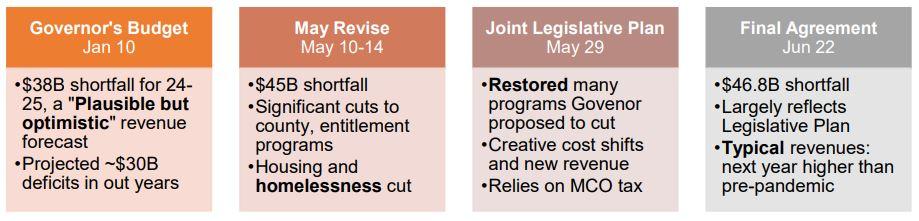
The Final Agreement largely reflected the Joint Legislative Budget Plan. Notably, the Legislature saved many programs important to counties that the May Revise proposed to cut: without increasing taxes or greater use of reserves. How? The Final Agreement is balanced by relying on some risky assumptions, including:
- Forecasting typical 5% revenue growth for the coming year, meaning higher than pre-pandemic levels in 2018-19. While recent state revenues have been strong (May’s taxes came in 24% and 125% above projections), forecasting a “typical” revenue year after two major deficit-defining years entails risk.
- Shifting $5.2 billion from the General Fund to the Greenhouse Gas Reduction Fund (GGRF) for programs from food security to fire resiliency. GGRF was able to absorb them thanks to a new, less conservative calculation methodology with higher 5-year estimates for Cap-and-Trade revenues.
- Assuming 1) the federal government will approve the state’s recent Managed Care Organization (MCO) tax model and 2) Proposition 35 does not pass in November. The Final Agreement repurposed a large portion of MCO revenues (previously intended for provider rate increases) for other Medi-Cal programs, however, Proposition 35 would mandate more MCO revenues go to provider rate increases and less to the general Medi-Cal system support the Final Agreement relies on.
General Government
- + Excess-ERAF provision not included to direct ERAF to charter schools (Marin revenue impact would have been $1.1M ongoing).
- Healthcare worker min. wage (SB 525) trigger language added to take effect if 1) revenues 3% higher than Q1 projections or 2) Hospital Quality Assurance Fee waiver data collection begins.
- Reparations implementation funding of $12M to enact legislation, though not for direct payments.
Health and Human Services
- + Homelessness funding for $1B HHAP 6 and $150M for Encampment Resolution Funding restored, though $260M HHAP Round 5 supplemental funding remains eliminated. $80M for Bringing Families Home for child-welfare involved delayed instead of eliminated, and $92.5M for Home Safe for elder abuse restored.
- + Future of Public Health funding restored at $184.1M ongoing for counties, including an 8% reduction – the same haircut all state departments got. Current-year reductions only affect the state.
- + IHSS benefit preserved for undocumented. IHSS Backup Provider System funding restored. Bill language included to update budget methodology for county IHSS administration funding.
- + CalWORKs restored $600M, including Single Allocation, Family Stabilization, and Expanded Subsidized Employment. Home Visiting and Behavioral Health reduced to align with utilization.
- + Foster care funding restored including: Rate Reform (with 1-year delay), County administration funding to speed caregiver approvals, and Family Urgent Response System for crisis support.
- + Adult Protective Services Expansion to lower age served from 65 to 60 fully funded.
- + CA Nutrition Incentive Program preserved, including funding for Market Match.
- - Childcare slot expansion delayed 2 years: state is pausing at 130,000 of its 200,000 new slots (includes 11,000 with letters already issued).
- - CalFresh food assistance to undocumented residents delayed 2 years – to October 2027.
- - Older Adult Behavioral Health Initiative funding of $35M reduced over 3 years.
- - Child Support Agencies funding cut $29M.
- Behavioral Health Continuum Infrastructure Program (BHCIP) cut $450.7M, however future rounds covered by Prop 1. BH Bridge Housing reduced by $340M, leaving $1B in the program.
- Prop 1 implementation funding for counties $85M.
- CARE Act funding reduced to counties to reflect lower utilization.
- Developmental Services Rate Reform delayed 6 months (as opposed to 1 year).
- Medi-Cal County Administration COLAs frozen temporarily until 2027.
Administration of Justice
- + Public Defender Pilot Program providing post-conviction services funded for 3rd year.
- + Victim Services Program received $103M in one-time funding to backfill volatile federal revenues to support various victim services.
- + Adult Reentry Grant funding maintained at $111M, provides CBOs funding for reentry services for formerly incarcerated individuals.
- - Medication Assisted Treatment grants cut $10.5M.
- Dept of Corrections and Rehabilitation cut $560M ongoing, including deactivation of 46 units in 13 prisons, and $120M cut to San Quentin project, as recommended by Advisory Council.
Housing, Infrastructure, Resources
- + Most cuts to affordable housing programs not restored – but $315M for Multifamily Housing Program, $560M for REAP 2.0 were.
- + Low-Income Housing Tax Credits maintained full $500M supplement funding.
- + Climate programs largely preserved, with $45B of original 2022 $54B climate package maintained.
- + Fire suppression shifted to GGRF. Funding included for new CAL FIRE 66-hour workweek, which increases contract county revenues.
- + Drought/flood relief for small farmers maintained by shifting $18M program to GGRF.
- + Extreme Heat and Community Resilience restored $40M, though $70M still cut.
- + Arts funding restored including lower $5M cut to CA Arts Council and restored $26M local grants. Performing Arts Equitable Payroll $12.5M restored.
- - Housing programs CalHome and Infill Infrastructure reduced, Adaptive Reuse and Foreclosure Intervention eliminated. $76M reverted for Veterans Housing and Homelessness Prevention. Prop 1 will support veterans' housing.
- Broadband $250M for Middle Mile maintained, with provisions to increase additional $250M if specified criteria met. $550M in Last Mile funding delayed 3 years to 2027.
- Active Transportation Program restored $200M of its original $600M proposed cut.
- Library funding partially restored, including Lunch at the Library (recently started in Marin).
View the document
This document may not work with all assistive technology and is being remediated. For alternative formats, please email Talia Smith or phone 415-473-6358. To use the California relay service, dial 711.