

Summary
November 8, 2024
The Honorable Governor Gavin Newsom
1021 O Street, Suite 9000
Sacramento, CA 95814
Re: $10M Support for Future of North Bay Agriculture in Governor’s Budget Proposal
Dear Governor Newsom,
On behalf of the Marin County Board of Supervisors, I write to you with an urgent request to consider funding in your Governor’s Budget Proposal to support the North Bay’s small-scale agriculture, dairy, and ranching operations, which are facing an existential threat. However, targeted state investments, along with the region’s long history of pioneering sustainability and resiliency – could pave the way for the North Bay to serve as a model for how small-scale, organic agriculture can thrive in a changing economy and climate.
For over a century, North Bay farmers, dairies and ranchers have prioritized environmental sustainability. Our region has proudly pioneered organic practices, carbon sequestration and land stewardship that have become a model for sustainable farming nationally. Though the industry faces the challenges outlined in this letter, it remains an important economy with $83 million and $945 million in annual total value in Marin and Sonoma counties, respectively. But as the cost of land, living, and regulatory compliance has soared, and housing and development has tightened – so too have costs for low-profit-margin farms.
As a result, 25 small-scale agricultural operations in Marin have closed in the past decade, including 8 dairies – and numerous others have reduced production substantially. Most all of these closures were organic operations: the wrong direction to support the state’s goal for 20% of California’s farmland to be organic by 2045. Critically, these closures threaten to further destabilize other organic, sustainable operations in the North Bay: small-scale farms can only achieve cost efficiencies by sharing them with the regional network.
In addition to the increasing cost and complexity of regulatory compliance that is challenging to spread over small production output, the region’s housing crisis remains a key linchpin. The North Bay’s high costs of living have left rural workers vulnerable to substandard housing conditions, commuting long distances – or simply leaving the region without enough workers. A recent study found that West Marin needs an additional 1,000 units of affordable housing.
This letter outlines the confluence of issues facing North Bay agriculture, and how a $10 million state investment, matched with $3 million in Marin resources would achieve long-term viability for the industry, create real solutions for housing, and help realize the state’s laudable climate goals. The $10 million state investment would be utilized for the following high-priority needs:
- $5,000,000 CDFA resources for regulatory reform and assistance (5-year pilot)
- $3,500,000 North Bay agricultural worker housing fund
- $1,500,000 support new economic opportunities, including agritourism
Together, this $13 million investment would not only safeguard the North Bay’s agricultural heritage but also provide a pathway to long-term sustainability for the region’s small-scale farmers. By investing in the future of Marin agriculture, we can preserve its environmental and organic leadership while ensuring that the local food supply remains resilient for generations to come.
A long history of resiliency and environmental sustainability
Since the mid-1800s, West Marin’s small farms and ranches have provided San Francisco Bay Area residents with locally-sourced, low-emission healthy food, particularly dairy. Marin’s landmark conservation-focused 1973 Countywide Plan concentrated growth to urban areas, protecting West Marin from sprawling suburban development seen in other Bay Area counties. Over the next few decades, the Marin Agricultural Land Trust (MALT) conserved tens of thousands of acres for agriculture.
Agriculture remains a critical component of Marin’s economy: Marin’s 121,800 acres of active farmland represent nearly one-fifth of the entire county, and in 2023 the total value of local agricultural production was $85 million, leading with poultry, followed by organic milk, and then cattle and crops.[1] Sonoma County has an additional 589,000 acres of active farmland.
What sets the North Bay’s agriculture apart is its pioneering commitment to environmental sustainability. Farmers and dairies in the region were some of the first in the nation to transition to organic and implement land stewardship; reducing pesticide use, and spearheading regenerative and carbon sequestration practices. The small-scale, often family-owned agricultural operations were able to embrace new, groundbreaking practices quickly and successfully – and paved a model for other operations throughout the country to follow.
We applaud the state’s ambitious goals to achieve 20% organic active farmland by 2045 and AB 1757’s greenhouse gas emission reduction targets for agricultural lands. The future of agriculture in California is widely-adopted sustainable practices, and Marin stands ready to continue to lead in soil health, agroforestry, and methane emission reductions. Small farms also provide local food systems resiliency. Larger, industrial agricultural operations that use monocropping and pesticides not only harm the surrounding natural environment, but also make crop yields more susceptible to extreme weather patterns. Small-scale farms have proved to be reliable local food sources during disruptions, such as the pandemic.
Slim Profit Margins and Fragile Economies of Scale
Unlike larger farms in other parts of California, small-scale agriculture in the North Bay operates on incredibly slim profit margins, due to the high regional costs for land and labor, and regulatory compliance. Small farms cannot alone achieve cost efficiencies through economies of scale or broader distribution networks that larger operations can. Sharing costs for essential services—like feed, transportation, and distribution—among the entire network of farms and dairies in the North Bay has kept the area’s farms afloat. However, sharing fixed costs also makes North Bay operations vulnerable when one, or a handful of operations close. Each closure pushes up cost burdens for those that remain.
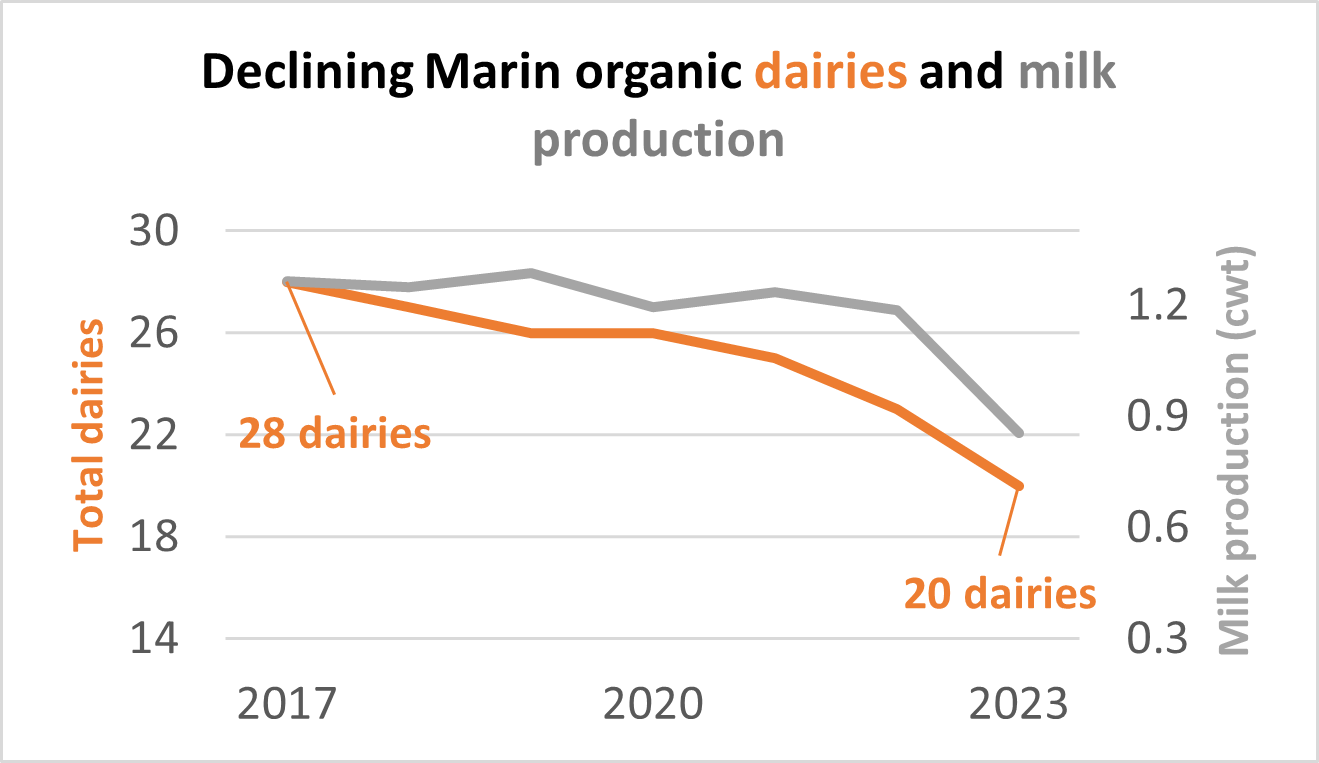
This trend and impact on the fragile sector remaining is alarming: since 2017, eight dairies in Marin have closed – leaving just 20 remaining. Milk production has decreased 32%. Slim profit margins also leave operations, particularly diaries, exceedingly vulnerable to fluctuations in milk prices, feed costs, and drought conditions.
CDFA has recognized the precarious financial positions of organic, small-scale dairies, and authorized emergency financial aid in 2023 in response to the simultaneous bottoming-out market sale prices and devastating operational cost increases, including 20-40% increases in the cost of organic feed. However, applying for those funds was administratively burdensome and costly for many small operations, and Marin County has not identified any local dairies that successfully received financial assistance from the program.
The Acute Housing Crunch in West Marin
An agricultural and rural economy cannot exist without the workforce to sustain it. As the Bay Area’s housing crisis has extended to western Marin and Sonoma counties, rural affordable housing has become increasingly scarce. The region’s workers, who often rely on low-wage work, are particularly vulnerable since proximity to employment is critical for the long hours of agricultural or related-industry work.
A recent study found that West Marin requires at least 1,000 new affordable housing units for households earning less than $65,000 per year, which is less than half the countywide median income of $142,000.[1] Exacerbating the challenge, the region's already limited housing stock—5,000 to 6,000 units—has been further reduced by the rise in short-term rentals and homes being purchased as second homes. The pandemic and remote work has driven demand from high-income professionals seeking rural, scenic areas. The net effect has been the removal of valuable housing stock from the region and higher rents for workforce housing.
After years of community discussions, our Board approved new regulations in May to address short-term rentals, which currently account for 16% of the 3,450 housing units in West Marin.[2]
The housing crisis has left rural workers vulnerable to substandard housing conditions, or commuting long distances – exacerbating transportation and financial burdens. With their low-profit margins, Marin’s small-scale farms and ranches are challenged to offer higher wages or raise the capital to finance and navigate the regulatory burdens associated with creating more on-site housing. Small family farming operations in the North Bay are facing these issues especially acutely due to the high pressures on the local housing market and the significant amount of surrounding Federal and state parklands.
A Unique Set of Regulatory Hurdles
North Bay dairies and agricultural operations face a distinct and complex set of regulatory and environmental compliance requirements compared to their counterparts in other parts of the state. This complexity stems from their coastal geography and proximity to state and national parklands, local watersheds, protected habitats, and the urban areas surrounding San Francisco Bay. In addition to local County Departments, numerous state and federal agencies have a regulatory role in Marin agricultural operations, including:
- CA Department of Food and Agriculture
- CA State Water Resources Control Board
- CA Coastal Commission
- CA Department of Conservation
- CA Department of Fish and Wildlife
- CA Department of Pesticide Regulation
- SF Bay Reg. Water Quality Control Board
- North Bay Regional Water Quality Control Board
- Bay Area Air Quality Mgmt District
- U.S. Army Corps of Engineers SF
- U.S. Environmental Protection Agency, Clean Water Act
- U.S. Department of Agriculture
- National Organic Program: Origin of Livestock (2022), Strengthening Organic Enforcement (2024), Organic Livestock & Poultry Standards (2024)
Compliance with these agencies’ requirements imposes costs and complexity that small operations cannot spread across large production scales, as larger farms do. Additionally, geographic-specific regulations to Marin such as from the North Bay Regional Water Quality Control Board and the California Coastal Commission require additional layers of complexity on small operations, especially when expanding or shifting operations, such as adding agritourism operations or worker housing.
In this regulatory environment, even seemingly simple issues become prohibitively expensive and time-consuming. For instance, surface water licensing, which governs pond maintenance, does not provide the flexibility farmers need to diversify operations. In a region like Marin, where groundwater sources are scarce, the ability to store surface water is essential. Yet, seeking to expand an existing pond’s use from just livestock to include crop irrigation requires navigating a complex, lengthy, multi-agency permitting process that can involve the farm needing to hire engineering and environmental expertise.
Maintaining existing ponds is also challenging. During the 2021 drought year, when many ponds were at record low levels, some farmers wanted to use the opportunity to dredge them to restore their intended capacity. However, securing the necessary permits proved difficult and costly. Faced with the length, cost and need to hire technical expertise to get through permitting, many operations did not pursue the needed maintenance.
Adding new, affordable on-site worker housing for farms presents the same challenges. In the North Bay, where water and septic infrastructure presents real constraints in rural areas, many farms face significant capital and regulatory costs in replacing inherited, decades-old septic and drinking water systems. Without external funding support, updating these systems can make much-needed housing projects simply cost-prohibitive for small farmers. Additionally, the sheer number of agencies that permits are required from means extended timelines and complexity.
New organic requirements present a growing burden
As noted, the organic label is not only a distinguishing feature of North Bay agriculture, but also pivotal to financial viability via higher sale prices. However, new federal requirements for organic certification are also presenting new and significant hardships for West Marin's small-scale agriculture. The North Bay’s local certifier Marin Organic Certified Agriculture (MOCA) is not able to manage increasingly burdensome, onerous and costly requirements with its existing limited resources and staffing and beginning in 2025 will have to drop its livestock, poultry, and processing organic certification categories because of them.
These changes threaten not only the future of MOCA but also the sustainability of the small-scale farms that rely on local certifiers for their organic certification. Unlike larger, out-of-county certifiers, MOCA offers community-based expertise and keeps certification costs low for producers already operating on thin profit margins. The potential loss of MOCA would mean that many small farms may either face higher fees from larger certifiers or choose to forgo organic certification altogether, undermining the very environmental and organic values that Marin County has championed for decades. These new federal regulations only add to the challenges West Marin organic agriculture is facing.
Diversification and new economic opportunities
Despite its challenges, the North Bay’s geographic location also offers an opportunity for revenue diversification, including through agritourism. Increasing pressure from rising operational costs, environmental regulations, and competition from large-scale industrial organic farms makes finding new economic opportunities a necessary strategy for some to achieve long-term economic sustainability. These opportunities could include tours, teaching sustainable practices, land stewardship, and farm-to-table experiences, allows farms to diversify their revenue streams while capitalizing on the region’s proximity to the San Francisco Bay Area to get visitors. Agritourism also creates new, effective marketing to increase demand for locally-sourced, sustainably-grown products.
However, transitioning for new opportunities requires investments in infrastructure and navigating complex land-use regulations—costs that small farms cannot bear alone. For North Bay’s operations with extremely limited profits, they are stuck on how to move forward. State and regional support are essential to helping these farms make this transition successfully, as the costs of navigating zoning and building permitting processes, technical expertise, and infrastructure including wastewater and visitor services all present a financial risk for operations that already lack marketing and other start-up cost support.
What $10 million State Investment Would Achieve
A $10 million investment from the state could significantly help address these challenges by focusing on targeted regulatory relief, infrastructure upgrades, and financial support for small-scale farms. The region has long served as a pioneer and provided an exportable model in sustainability, zoning and environmental stewardship – and this investment would pave the way for the North Bay to once again model how a small-scale, sustainable agriculture region can thrive in a changing economy and climate.
The state’s investment would be matched by $3 million in local Marin County funds for a broader $13 million initiative that demonstrates strong local and state partnership and support to ensure the future of the North Bay agriculture economy.
Marin County’s $3 million commitment:
$2,000,000 support infrastructure needs in West Marin, including for visitors
$500,000 address substandard rural housing
$60,000 review County policies to better support agritourism
$440,000 local investments to complement the state’s $10 million investment
$3,000,000
Proposed state $10 million investment:
$5,000,000 1. CDFA resources for regulatory reform & assistance (5-year pilot)
$3,500,000 2. North Bay agricultural worker housing fund
$1,500,000 3. New economic opportunities, including agritourism
$10,000,000
1. CDFA resources for regulatory reform and assistance targeted to North Coast, small-scale agriculture (5-year pilot) – $5 million
Aside from direct financial relief, an initiative that would provide meaningful help to small-scale operations is identifying where regulatory reform can be implemented. Our request would be to establish limited-term staffing resources within CDFA for a 5-year pilot period focused on small-scale, North Coast agricultural operations (coastal counties from Marin to Del Norte) to:1) identify opportunities to streamline/relieve regulatory processes and reduce time and costs by coordinating approvals, eliminating redundancies in permitting, paperwork, reviews, etc.; and 2) provide technical assistance at low or no cost to operations in navigating the regulatory processes still required. The intent would be to provide lasting regulatory reform and assistance for processes at all state agencies – not just CDFA.
At the end of the 5-year pilot, the unit would provide a report to the Legislature detailing recommendations for:
- Permitting and regulatory streamlining to eliminate redundancy, reducing costs and administrative burdens on small operations, including “cutting the green tape” regulatory relief on environmentally beneficial practices such as carbon sequestration, rainwater capture, and soil health improvements.
- Changes to CDFA grant programs to ensure statewide funding reaches small-scale operations with slim profit margins, and limited resources to apply for grants.
- Regional economic planning efforts and other solutions to safeguard the future of North Coast small-scale, sustainable agriculture and food systems. This could include strategies for revenue diversification and housing initiatives.
2. North Bay agricultural and rural worker housing leverage fund – $3.5 million
This investment would set aside state funds in a “leverage fund” to match local and private investments for affordable rural worker housing needs in Marin and Sonoma counties. Farm closures in recent years in Marin have left long-time, on-farm residents – without housing. This fund would support both interim housing needs (purchase of mobile homes) and long-term needs (costs associated with new on-site housing such as septic and water upgrades). Having leverage funding available would also allow quick action to prevent displacement.
Though many agricultural operations in the North Bay want to provide new on-site worker housing opportunities, it is not financially feasible for many property owners without significant external financial support. This fund, in combination with other local sources including the County and Community Foundation, would provide an opportunity to fill in gaps to advance housing projects – and keep them affordable.
Importantly, funds should be managed and distributed by a local entity that is already familiar to North Bay agricultural operations, can best provide technical assistance and expertise in reviewing local projects. They can also ensure funds are distributed efficiently, with minimal administrative overhead. There are a number of local entities with a strong local understanding of what the North Bay’s agricultural operations needs are, including the local Resource Conservation District, Agricultural Institute of Marin, Marin Agricultural Land Trust, Community Land Trust of West Marin, and the County of Marin. Strong accountability measures would be put in place for the local distribution of funds from the housing fund.
3. New economic opportunities – $1.5 million
The funds could also be used to help small farms diversify their revenue streams through new economic opportunities, including grants for farms to invest in the infrastructure needed to transition to agritourism or diversify operations. This could include landowner outreach and technical assistance, improving land access for new and/or underrepresented farmers, processing and marketing assistance, and capital needs such as upgrading visitor facilities or access roads. Marin presents unique opportunities for revenue diversification and agriculture-related tourism and education, including AIM’s Center for Food and Agricultural at the Civic Center campus. An investment to help farms diversify would greatly support these initiatives.
Thank you
We thank you for your consideration of this urgent, and meaningful request. Small-scale agriculture in our community is at an important crossroads – and we see an opportunity to set things in the right direction not only for our community, but also for California’s broader climate goals. Marin is more than ready to do our part in this effort, and we implore your leadership and assistance to join our effort to preserve this vulnerable sector for the well-being of generations of Northern Californians to come.
In partnership,
Dennis Rodoni, President, Marin County Board of Supervisors
Cc: Marin County Board of Supervisors
Senator Mike McGuire
Assemblymember Damon Connolly
Karen Ross, Secretary of California Department of Food and Agriculture
Sonoma County Board of Supervisors
Joe Deviney, Marin County Agricultural Commissioner
Andrew F. Smith, Sonoma County Agricultural Commissioner
View the document
This document may not work with all assistive technology and is being remediated. For alternative formats, please email Talia Smith or phone 415-473-6358. To use the California relay service, dial 711.