
Body of News Release
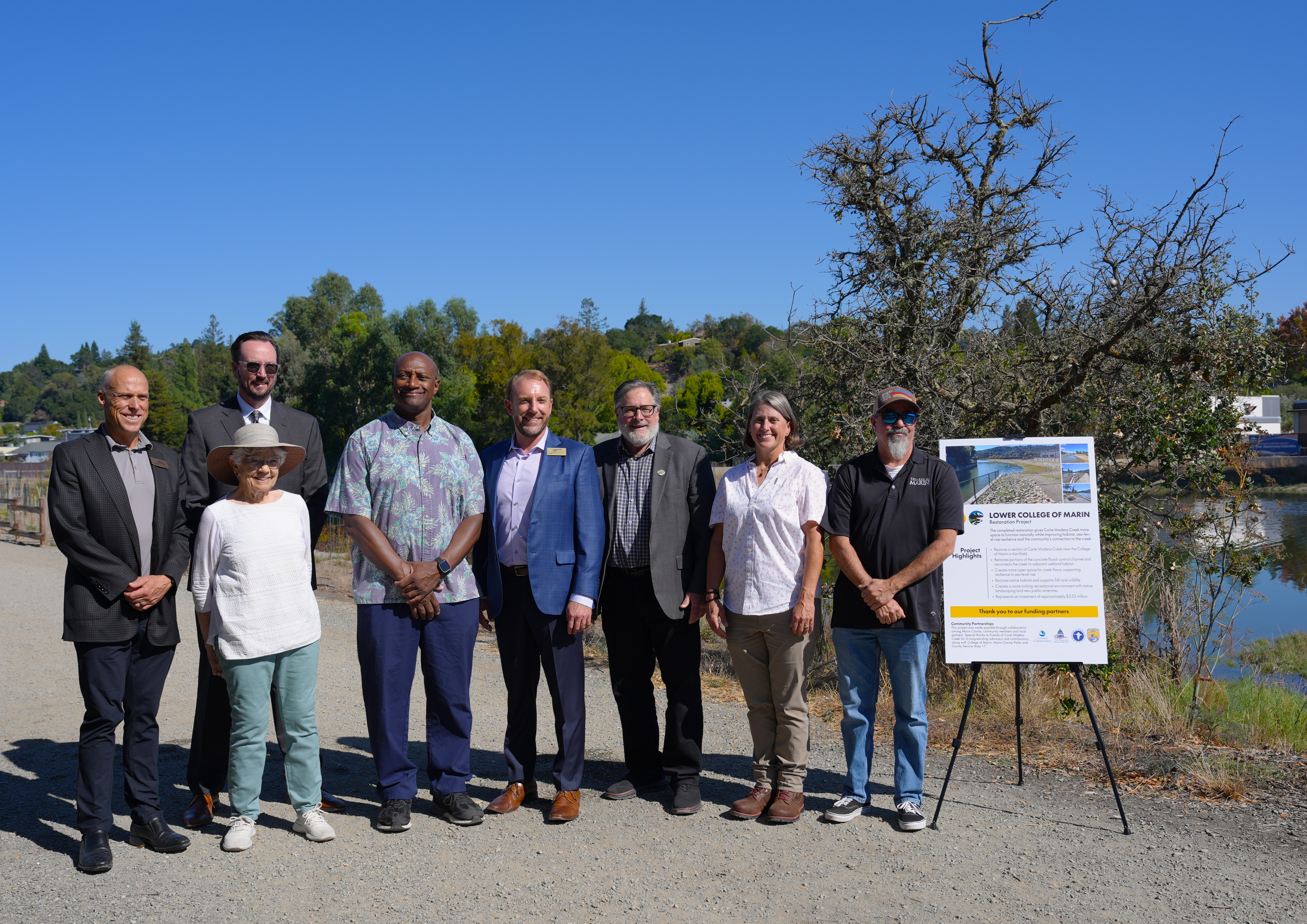
Marin County, CA – Marin County officials, community members and project partners gathered October 8 along Corte Madera Creek in Kentfield to celebrate completion of a project that transforms portions of a concrete flood-control channel into restored wetland habitat and community amenities.
The Lower College of Marin Restoration Project is located along the southern section of Corte Madera Creek behind the College of Marin campus. Work included removing portions of concrete channel walls constructed by the U.S. Army Corps of Engineers in the 1960s and 1970s and restoring the adjacent creek bank and wetlands.
The improvements create more space for creek flows, which provides greater adaptation for sea-level rise, and improves wildlife habitat. The project also includes native revegetation and improvements to the public area along the Corte Madera pathway south of Stadium Way, including new seating, landscaping, and other amenities that create a more active space for public enjoyment.
District 2 Supervisor Brian Colbert, whose district includes Kentfield, joined District 4 Supervisor Dennis Rodoni, whose district includes communities farther downstream along Corte Madera Creek, and County Executive Derek Johnson for the project completion celebration.
“This project shows what we can accomplish when environmental restoration and the community’s connection to the creek are considered together,” Rodoni said. “This restoration creates valuable habitat, greater resilience against sea-level rise, and provides a more natural setting for the community to enjoy.”
Supervisor Colbert focused on the long-term benefits to both the creek and surrounding community.
“This project is a great example of an investment that delivers multiple benefits for our community,” Colbert said. “We’re improving the creek and its natural environment while creating a more welcoming public space for people to walk, gather and enjoy. It’s exciting to see this long-planned project completed and delivering benefits that will last for years to come.”
Community and partner involvement played an important role in moving the restoration forward, County officials noted. In particular, the community group Friends of Corte Madera Creek Watershed had the vision and commitment to help reach this milestone.
“This project is an example that is feasible, fundable, and scalable,” said Sandra Guldman, President of Friends of Corte Madera Creek Watershed. “We can build on this success by moving upstream, restoring the creek while mitigating flood risk for the surrounding community.”
At the event, County officials recognized and credited collaboration among Friends of Corte Madera Creek Watershed, the College of Marin, Marin County Parks and County Service Area 17 with helping complete the project design and secure construction funding.
“This project benefited tremendously from people who have cared for and advocated for Corte Madera Creek over many years,” Colbert said. “Friends of Corte Madera Creek brought invaluable knowledge of the creek, its habitat and the surrounding community to this effort. That kind of sustained community involvement makes better projects possible.”
The approximately $3.8 million project investment, including design and construction, was supported by local, state, and federal funding, including $1.86 million from the California Coastal Conservancy, $750,000 in American Rescue Plan Act funding dedicated to sea level rise, $555,000 from the U.S. Fish and Wildlife Service National Coastal Wetlands Conservation Grant Program, $515,000 from the California Department of Water Resources Proposition 1E funds, and Flood Control District Zone 9 staff time and project management. An additional $156,000 National Fish and Wildlife Foundation grant supported native planting and revegetation.