

On March 11, 2025, the County of Marin passed a Shelter Crisis Declaration (Resolution 2025-14) to apply in the unincorporated areas of the County for the next three years to support housing and shelter options for people experiencing or at risk of homelessness. The Shelter Crisis Declaration allows the County to take action related to emergency shelter on County owned or leased lands.
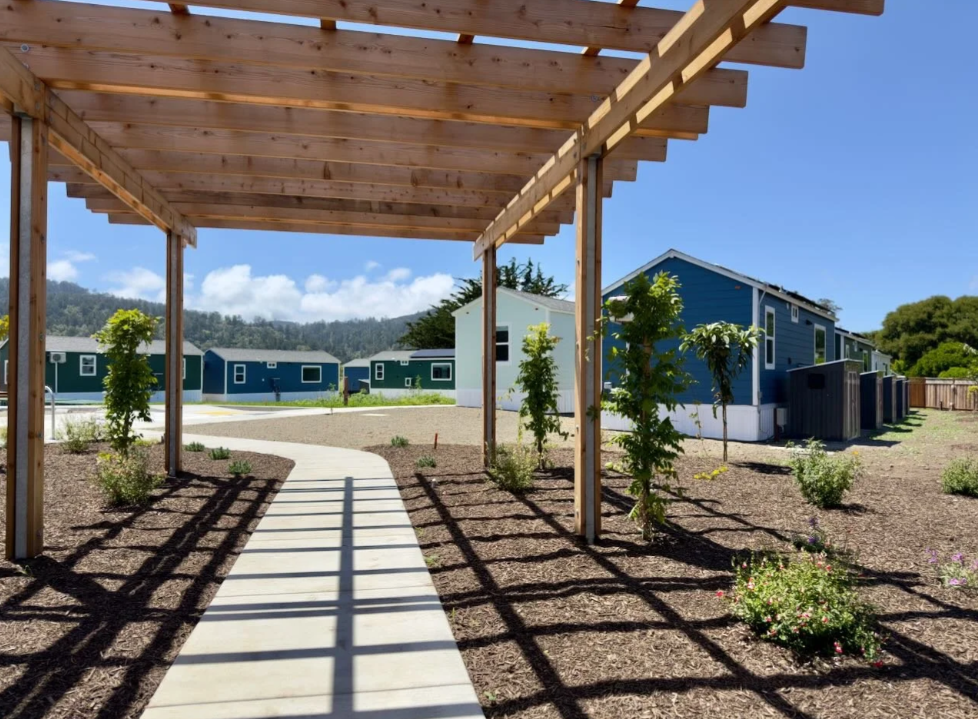
The building code provisions that the County adopted concurrently with the Shelter Crisis Declaration (Ordinance 3829) also provide private property owners options to legally create low barrier living arrangements on their properties during the shelter crisis, including relocatable cabins ("tiny homes"), mobile homes, or other facilities without a permanent foundation. Any structures built or reconfigured under the Shelter Crisis Declaration cannot be used as a short-term rental. Learn more below and submit an interest form to get started.
Projects
Learn more about proposed and operational projects under the Shelter Crisis Declaration.
Frequently asked questions
To address homelessness, the County has adopted a Housing First strategy which means that the County believes the solution to homelessness is to build and support permanent housing options.
The County has made significant progress providing housing and shelter to Marin’s homeless population, including:
- Sheltering 2,596 unique individuals
- Providing transitional housing to 318 unique individuals
- Housing 819 chronically homeless individuals through permanent supportive housing
- Connecting 1,423 additional individuals to housing through strategies such as Rapid Rehousing since 2017
- Supporting the development of five properties through the State Homekey Program leading to 151 units of permanent supportive housing
However, despite this progress, these shelter and housing resources are not adequate to keep up with the immediate needs of the homeless population. Additionally, with large-scale displacement occurring across agricultural lands in West Marin and the Point Reyes National Seashore, housing needs are increasing rapidly.
The streamlined entitlement process allowed by the Shelter Crisis Declaration applies only to public facilities. However, the Board of Supervisors on March 11, 2025 also adopted Ordinance 3829, which amends the Building Code to allow for different types of structures on any property.
No, the Shelter Crisis applies in unincorporated Marin only. Use our jurisdiction look-up tool to confirm whether an address or parcel is located in unincorporated Marin.
The total number of units permissible on your property depends on your property’s zoning as well as the capacity of essential site infrastructure, including water and wastewater systems.
To learn more about your property’s zoning, contact the Planning Department. To learn more about water and wastewater capacity, contact the Environmental Health Services Department.
The amended Building Code under the Shelter Crisis Declaration allows for the installation of emergency housing without permanent foundation, such as tiny homes, tiny homes on wheels and mobile homes. The Code also includes provisions to support reconfiguring an existing structure as emergency housing.
Increasing a bedroom count to a system can be impossible for some property owners and can mean costly upgrades to older septic systems, but there are some ways that septic systems and even homes can be modified that may reduce the cost involved and increase capacity:
- A bedroom swap. A bedroom, for example in the form of an ADU, can be added onto a home while at the same time another bedroom in the home can be “removed”, by way of disqualifying it from the regulatory definition of a bedroom addition. The existing bedroom will need to be modified to remove the expectation of privacy, such as opening up the doorway and removing the door, or removing a wall, and deed restricting the room for the lifetime of the home.
- Pretreatment unit. Adding an approved pretreatment unit (additional tanks may need to be installed) onto an existing standard Class I system in good working order. This will allow the system to accept an increased volume of daily flows and an additional bedroom.
- Low-flow fixtures. Applicable for some older Class I systems designed on the basis of 150 gallons used per bedroom per day, you can switch out your shower/s and sink fixtures to low flow water saving fixtures (ASTM 1- 1.6 gallon per flush toilets & 2.5 gallon per minute shower heads). The system can be reclassified to give low flow reduction credit at 105 gallons per bedroom per day. For three bedroom homes and greater, the credit allows for an additional bedroom.
- Increasing field size. For some class I systems it may be feasible to increase the field size to accommodate an additional bedroom.
You can contact EHS staff for a property records check to see if one of these options might work for you. Note that all systems will need an inspection prior to upgrade. Engineering work may be required to support upgrades.
No, any housing created, placed or reconfigured under the Shelter Crisis cannot be used as a short-term rental.
To help address the shortage of emergency housing and shelter, the County is exploring a number of projects and programs. Through a partnership with the Community Land Trust Association of West Marin (CLAM), temporary shelter under the Shelter Crisis is being explored on a vacant lot at the corner of 6th and B Street in Point Reyes Station. Learn more about this project and next steps on the project webpage.
News and updates
- New Housing Community Opens for Displaced West Marin Families July 10, 2026: County partnership with CLAM provides immediate assistance while advancing long-term affordable housing goals.
- Land Purchase Heads to Board; Parcel Eyed for Homeless Shelter August 22, 2025: A one-acre lot in Point Reyes Station is needed during shelter crisis declaration.
- County Declares Shelter Crisis to Provide Temporary Emergency Housing March 12, 2025: Removeable cabins, recreational vehicles could provide temporary shelter while permanent housing solutions are added.
- Marin County Considers Declaring Shelter Crisis March 6, 2025: Move by Supervisors would ease addition of temporary emergency dwellings.
Related
- Read about Housing First Housing First is an evidence-based approach that connects individuals to permanent, affordable housing quickly and without any pre-conditions.
-
Housing help
Find resources to help you locate or maintain housing.
-
How to apply for a building permit
Understand which permit process applies to you. We have 2 processes depending on what you need.