
The Regional Housing Needs Allocation (RHNA) is the target number of homes across income levels each city and county need to plan for as part of their Housing Element.
The California Department of Housing and Community Development (HCD) sets housing targets for each region of our state. Marin’s region includes the nine Bay Area counties. The Association of Bay Area Governments (ABAG) oversees the process of splitting the regional target across the 109 cities and counties in the Bay Area. For the current cycle, the targets are:
- Region (Bay Area): 441,176 units
- Marin County (overall): 14,210 units
- Unincorporated Marin: 3,569 units
We are required to show HCD how we are going to meet this target through our Housing Element plan. HCD also requires us to submit Annual Progress Reports to make sure we are staying on track. The State can impose fines on us if we do not meet our targets.
Unincorporated Marin RHNA goals
Of the 3,569 assigned to unincorporated Marin:
- 1,100 units (37%) for households earning a very-low income and under
- 634 units (14%) for households earning a low-income
- 512 units (18%) for households earning a moderate-income
- 1,323 units (31%) for households earning an above moderate-income
The 2025 Marin County income limits by household size shows the latest annual income thresholds for the categories above in Marin County.
Key dashboard highlights (2023-2025)
- As of the end of 2025, 344 total units have been permitted, representing approximately 10% of the total RHNA target of 3,569 units.
- The County is allowed to count 280 Accessory Dwelling Units (ADUs) towards the RHNA based on historic permit activity; 189 units have been permitted to date, representing 67% of this allowance.
- ADUs represent 55% of all permitted units, followed by single-family homes at 23% and multifamily projects of 5 units or more at 22%.
- Progress toward specific income targets stands at 13% for Low Income (634 unit goal), 11% for Above Moderate Income (1,323 unit goal), 9% for Moderate Income (512 unit goal), and 6% for Very Low Income (1,100 unit goal).
- Annual data shows that while 2023 had the highest volume of lower-income permits, 2025 saw the highest single-year total for Above Moderate units with 86 permits issued.
Dashboard progress
-
Unincorporated Marin RHNA Progress
Content textThis interactive dashboard shows units permitted and counted towards the RHNA through 2025.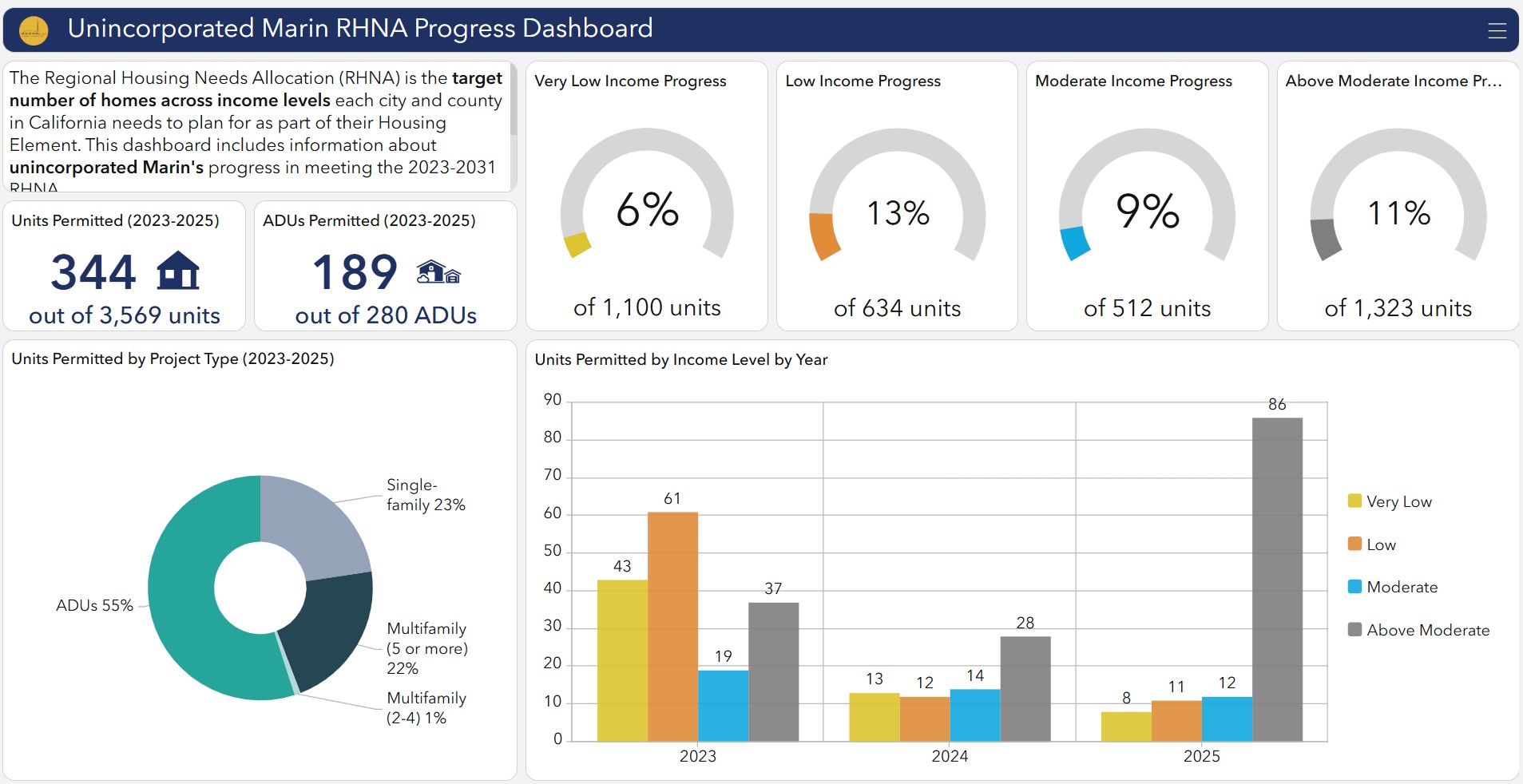
What goes into setting the unit goals?
The RHNA considers a number of factors, including:
- Public input, surveys, trends, and population analysis
- Population and business growth predictions
- Zoning changes
- Understanding affordable housing needs by location
- Impact of long commutes on our environment
- The benefits of increased housing density
- Access to jobs
- Addressing historic patterns of segregation with a focus on fair housing
- Encouraging lower-income housing in higher-resourced areas
Learn more about the methodology on ABAG's website.
Related
-
Housing Element sites
The Housing Element includes an inventory of sites where housing could be proposed.
-
2023-2031 Marin County Housing Element
Find our latest Housing Element which includes a needs assessment and action plan.
-
Annual Progress Reports
The Annual Progress Report shows housing development in each calendar year.