
What is West Marin Visioning?
| In short, this project is: |
|---|
|
The West Marin Visioning initiative is a community-driven effort to define a shared, long-term vision for the future of West Marin. This collaborative process will bring together community members, businesses, community organizations, and public agencies to define priorities that support a resilient environment, a thriving local economy, and vibrant communities.
In 2025, the Marin County Board of Supervisors designated Community and Economic Vitality (C&EV) as one of its six priorities, with the Community Development Agency (CDA) leading the West Marin Visioning under this work plan. This initiative is part of Marin County’s broader commitment to Community and Economic Vitality.
The resulting vision will serve as a guiding framework for future planning, investment, and policy discussions, helping ensure that decisions reflect community values while responding to ever changing conditions.
Para obtener información en español, busque la flechita donde dice “English” más arriba para cambiar el idioma de esta página web, o contactenos aquí.
What is the purpose of the West Marin Visioning?
| This project will aim to: |
|---|
|
West Marin is a unique and interconnected region with distinct communities, strong local identity, and significant environmental resources.
The vision will help align County decisions and investments with community priorities. It is designed to coordinate (not duplicate) existing and past efforts and create a unified direction for West Marin.
This initiative is primarily a public outreach and engagement process that will result in a clear and accessible vision document.
What area does this project cover?
The project boundary for West Marin Visioning encompasses the geographic areas of unincorporated Marin County subject to the 2018 Transient Occupancy Tax Measure W area. This includes the coastal and inland communities of Dillon Beach, Tomales, Chileno Valley, Hicks Valley, Marshall, Inverness, Point Reyes Station, Olema, Nicasio, San Geronimo Valley (including Forest Knolls, Lagunitas, San Geronimo, and Woodacre), Bolinas, Stinson Beach, and Muir Beach. Lands owned or managed by federal or state agencies—such as National Park Service units (Point Reyes National Seashore, Golden Gate National Recreation Area) and California State Parks (Mount Tamalpais State Park, Tomales Bay State Park)—are excluded from the project scope.
We are using this geographic area because the communities of West Marin are close-knit, highly engaged, and deeply interconnected, with strong relationships among residents, local institutions, and systems. Defining it as a single planning area builds on existing County policies, partnerships, and investments, allowing for more coordinated services and better use of resources.
-
West Marin Map
Content textThis map shows the West Marin area.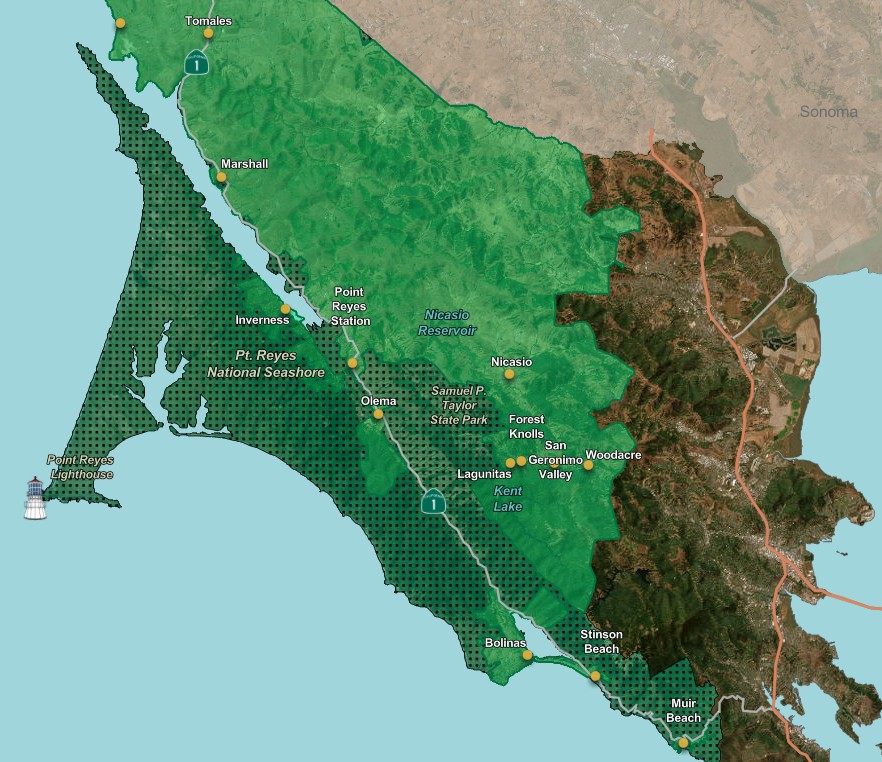
How do I get involved?
Community input is the foundation of this effort and will shape the vision. The project team is planning to conduct early community engagement to help inform the development of a consultant Request for Proposal (RFP). Initial input will help shape a Request for Proposal (RFP). For more information about the RFP, review the Frequently Asked Questions page.
We plan on hosting in-person meetings and opportunities for online engagement. We'll be announcing ways to participate as the project moves forward. Please stay tuned for upcoming chances to get involved and share your ideas.
Sign up for the listserv to receive timely updates and find out about upcoming engagement opportunities.
How else can I stay informed about this project?
Development of the consultant RFP and recruitment of the Community Advisory Group (CAG) represent early phases of this planning process. There will be many opportunities for you to participate throughout this process, and it is important to emphasize that the CAG is not the only way to participate in this long-range planning process. While the CAG offers a formal avenue for involvement, all community members are encouraged to attend outreach events, respond to surveys, and share their perspectives to help develop a shared, long-term vision for West Marin’s coastal and inland rural communities.
Sign up for the listserv to receive timely updates and find out about upcoming events.
Have a question or comment? Send us an email .
What is the project timeline?
-
step-in-progress
Summer 2026 – Winter 2026/2027
- Board of Supervisors hearing to authorize CAG formation and adoption of bylaws
- Initiate CAG recruitment
- CAG Appointment
-
step-pending
Spring 2027 – Spring 2029 (anticipated)
- Consultant selection
- Public engagement, outreach, and technical studies
- Community workshops and surveys
-
step-pending
Spring 2029 – January 2030
- Visioning document is drafted
- Community review of draft Vision
- Planning Commission and Board of Supervisors’ hearings to review and adopt the West Marin Vision
-
step-pending
January 2030
- Final Vision document is published following adoption by the Board of Supervisors
Board of Supervisors meeting - West Marin Visioning
Meeting Details
Documents
The documents in this list may not work with all assistive technology and are being remediated. For alternative formats, please email CDA Accessibility or phone 415-473-6269. To use the California relay service, dial 711.