Summary
The following report was provided to the Board of Supervisors for the September 29, 2026 meeting.
View the PDF of the Informational Report here.
Proposition 1: Authorizes Bonds for Housing Affordability Programs
Recommended position: Support
Summary: Proposition 1 authorizes the state to issue an $11.25 billion general obligation bond to finance affordable housing programs. Of the total amount, $10 billion would support the acquisition, construction, rehabilitation, and preservation of affordable housing, and $1.25 billion would fund veterans' housing programs. Bond proceeds would be distributed across several housing categories, including affordable multifamily housing, homeownership assistance, infrastructure, farmworker housing, higher education student housing, tribal housing, local pilot programs, and veterans' housing.
Proposed Uses of Bond Funds (in millions)
| State Housing Programs | $10,000 |
| Affordable Multifamily Housing | $7,200 |
| Homeownership | $1,100 |
| Infrastructure | $500 |
| Farmworker Housing | $450 |
| Higher Education student housing | $350 |
| Tribal Housing | $200 |
| Local pilot Programs | $200 |
| Veterans Housing Programs | $1,250 |
| Total | $11,250 |
According to the Legislative Analyst's Office (LAO), repayment of the bond would increase General Fund expenditures by approximately $500 million to $600 million annually for about 25 years. The measure would finance housing investments through long-term borrowing, with debt service paid from the state's General Fund.
| Supporters | Opponents |
|---|---|
|
|
OCE Analysis: Supporting state and federal funding opportunities for new affordable and accessible housing construction is a key point in the board’s 2026 Legislative Platform. The Regional Housing Need Assessment (RHNA) is a state-mandated process to develop local city and county level goals for housing development that align with forecast growth patterns, resulting in assigned targets for the number of affordable housing units per income level. In the most recently adopted RHNA approved by the California Department of Housing and Community Development (HCD), Marin County was required to accommodate development of 14,210 new units between 2023 to 2031, of which 3,569 are in unincorporated Marin.
Proposition 1 would increase housing grant and financing opportunities for Marin and broadly throughout the Bay Area. Marin’s affordable housing projects have historically benefited from state funding made available from state housing programs that Prop. 1 would fund. For example, the Oak Hill project received $42 million from the state Multifamily Housing Program, and the Coast Guard Property in Pt. Reyes Station received $11.5M from the state Joe Serna, Jr. Farmworker Housing grant program.
A Support position is recommended.
Proposition 2: Increases State’s Rainy Day Fund
Recommended position: No position
Summary: Proposition 2 increases the maximum required size of the state's Budget Stabilization Account, or “Rainy Day Fund,” from 10 percent to 20 percent of General Fund tax revenues. The measure also requires larger deposits during years in which “excess” revenues from capital gains taxes are greater than 8 percent of total General Fund tax revenues. These changes are intended to increase state budget reserves during periods of strong economic growth.
Proposition 2 extends the state's requirement to make supplemental debt payments through 2040, rather than ending in 2030. It also expands the allowable uses of these payments to include required payments to schools and community colleges, repayment of borrowing from other state funds, and repayment of certain federal loans. Payments for federal loans for unemployment insurance benefits during the COVID-19 pandemic would become a permissible use of set-aside revenues, which would potentially shift a cost currently borne by employers to state funding.
Proposition 2 also revises accounting requirements for limits on state appropriations such that deposits to reserve accounts are not included, but instead use of reserve funds are included in appropriations limit calculations. The measure changes how reserve funds and supplemental payments are managed but does not establish new revenue sources.
| Supporters | Opponents |
|---|---|
|
|
OCE Analysis: The County benefits from a fiscally stable State budget, as state funding supports many County-administered programs and services. Proposition 2 would modify the state's budget reserve policies by increasing the Rainy Day Fund target and extending supplemental debt payments, which could improve California's long-term fiscal resilience during economic downturns. Increased rates of deposits to the Rainy Day Fund or debt payments could result in fewer expenditures of one-time funds supporting County programs infrastructure projects.
However, the measure primarily concerns state budget management and does not directly affect County operations or advance a specific priority identified in your Board's 2026 Legislative Platform. Accordingly, a No Position recommendation is appropriate.
Proposition 3: Provides Permanent Funding for Schools and Health Care by Extending Existing Tax on High Incomes
Recommended position: Support
Summary: Proposition 3 permanently extends the temporary income tax on high-income earners that voters approved in 2012, which is currently scheduled to expire in 2031. The tax applies to taxable household income exceeding $721,000 for couples and $360,000 for individuals and can reach a maximum rate of 12 percent. According to the measure, the tax generates between $5 billion and $15 billion annually.
Approximately 40 percent of the revenue would continue to support K-12 schools and community colleges, while the remaining funds would support other state programs and budget reserves that may be used when revenues decline.
| Supporters | Opponents |
|---|---|
|
|
OCE Analysis: The Board's 2026 Legislative Platform supports sustained state investment in education, health care, behavioral health, affordable housing, climate resilience, and other programs that benefit Marin County residents. Proposition 3 would preserve an existing source of state revenue that supports many of these priorities. Additionally, following enactment of the 2026-27 State Budget the LAO currently forecasts that California faces a structural, multiyear deficit of $8 billion to $20 billion annually, without considering potential state responses to impacts from federal policy changes reducing funding for safety net services. Loss of the revenue generated by this additional increment on state income tax would further compound the fiscal challenges that the structural deficit will present. While the Legislative Platform does not specifically recommend positions on statewide tax structures or revenue mechanisms, because the measure advances needed state support for platform aligned programs, a Support recommendation is consistent with the Board's adopted legislative priorities.
Proposition 4: Repeals Prohibition Against Public Funding of Election Campaigns
Recommended position: No position
Summary: Proposition 4 repeals the constitutional prohibition on using public funds to finance political campaigns, allowing state and local governments to establish voluntary public campaign financing programs if they choose. The measure does not create a statewide or local financing program but instead authorizes future governments to develop their own programs.
It establishes general requirements governing the use of public funds, candidate eligibility, spending limits, allowable expenditures, and restrictions on the use of funds, including prohibiting the use of education, transportation, and public safety funds for campaign purposes.
The measure also specifies that the Fair Political Practices Commission (FPPC) would not be required to administer or enforce local public campaign financing programs. State and local governments could request guidance from the FPPC when developing programs consistent with the measure. According to the LAO, the measure would result in ongoing state costs of a few hundred thousand dollars annually for the FPPC to provide technical guidance to state and local governments, however any additional public expenditure toward campaign financing remains contingent upon future decisions.
| Supporters | Opponents |
|---|---|
|
|
OCE Analysis: Proposition 4 would authorize, but not require, state and local governments to establish voluntary public campaign financing programs. The measure would not create a statewide program or impose new responsibilities on counties unless adopted through future local action. The Board's 2026 Legislative Platform articulates support for “campaign finance reform that limits excessive political spending,” but does not expressly address public financing of elections as an alternative. As the measure has limited direct operational or fiscal impacts on Marin County and does not advance or conflict with an adopted legislative priority, a No Position recommendation is appropriate.
Proposition 5: Changes Recall Election Process for Statewide Elections
Recommended position: No position
Summary: Proposition 5 would revise California's process for recalling state elected officials by eliminating the second question on recall ballots that asks voters to select a replacement candidate, except in recalls involving the Governor. Under the measure, voters would decide only whether to remove the elected official from office. If a recall succeeds, vacancies would be filled using the state's existing vacancy procedures. Legislative vacancies would generally be filled through a special election, while the Governor would appoint replacements to most other state offices.
The measure also changes the succession process for gubernatorial recalls. If the Governor is recalled during the first two years of the term before the nomination period for the next statewide election closes, the Lieutenant Governor would serve until voters elect a new Governor. If the recall occurs later in the term, the Lieutenant Governor would serve for the remainder of the term. According to the LAO, the net fiscal effect is unknown and could result in either savings or costs of millions of dollars depending on the office subject to recall and frequency of such recall efforts. While removing the second question from the ballot when considering the recall of a Governor would reduce costs, conducting special elections to fill other vacancies emerging from recalls would increase costs.
| Supporters | Opponents |
|---|---|
|
|
OCE Analysis: Proposition 5 would revise procedures governing recalls of statewide elected officials but would not change the administration of local elections or the authority of county governments. Because county governments administer elections on behalf of the State, there is a possibility that some additional costs for conducting additional elections under Proposition 5 terms for filling vacancies will be incurred. The extent to which additional costs are passed to county governments or shared with the state is contingent upon future legislative decisions. Because the Board's 2026 Legislative Platform does not establish policy regarding statewide recall procedures, a No Position recommendation is consistent with the Platform.
Proposition 37: Creates Loan Program for Middle-Income Buyers of Qualified New Homes
Recommended position: Support
Summary: Proposition 37 establishes a $25 billion bond-financed mortgage loan program to assist home buyers with incomes below 200% of the area median income. The program would provide fixed-rate mortgage loans covering up to 17 percent of the purchase price for homes valued at less than $1.5 million. To qualify, home buyers would be required to contribute at least 3 percent toward their down payment. Monthly payments for loans issued through this program would be structured to keep interest rates low while also recovering any associated administrative costs.
This measure would allow all developers to build homes eligible for purchase through the program. Developers could also choose to participate in a “qualified builder option,” which would require them to meet additional labor standards, including using workers with specified training requirements for certain housing projects. In exchange, participating developers would be subject to different construction defect rules that generally provide greater flexibility in addressing construction-related claims.
According to the LAO, Proposition 37 does not create direct state or local government costs because mortgage payments from participating home buyers would be used to repay bond investors.
| Supporters | Opponents |
|---|---|
|
|
OCE Analysis: Expanding affordable homeownership is included in your Board's 2026 Legislative Platform. The Platform supports increased state investments that expand homeownership, workforce housing, and housing affordability, particularly for moderate- and middle-income households that face significant barriers to purchasing homes in Marin County's housing market. Proposition 37 would create a statewide mortgage assistance program designed to reduce upfront homeownership costs for eligible buyers. While the program would not directly increase housing production, it could improve access to homeownership for Marin residents and complement the County's broader housing objectives. Accordingly, a Support position for Proposition 37 is consistent with your Board's adopted housing priorities.
Proposition 38: Authorizes Bonds for Immunology Medical Research
Recommended position: No position
Summary: Proposition 38 authorizes the state to issue $8.4 billion in general obligation bonds to fund research focused on immunology and immunotherapy. Immunology is the study of the immune system and how it protects the body from diseases and abnormal cells, while immunotherapy develops treatments that help the immune system fight illnesses more effectively. The measure requires that at least $4.2 billion of bond funding be dedicated to immunology research involving cancer, heart disease, and Alzheimer’s disease. No more than 2 percent of total bond funds could be used for associated state administrative costs. Funding would be distributed for research activities, and repayment of the bonds would come from the state General Fund.
The measure defines which entities are eligible to receive this new research funding and how funding would be allocated:
• $4 billion to nonprofit and public university researchers via a competitive grant process
• $4 billion to nonprofits focused on immunology and immunotherapy research, founded before 2025, affiliated with a University of California campus with a medical center, and meeting specified size and donation requirements (likely limiting the only eligible entity as the California Institute for Immunology and Immunotherapy)
The LAO estimates that Proposition 38 would increase state costs by approximately $500 million to $600 million annually for about 20 years to repay associated bonds. The measure requires that 10 percent of any revenue generated from funded research be used to repay the costs of the bond, with any further revenues being utilized to support future immunology and immunotherapy research. The extent to which research will yield revenues and support repayment of associated debt is uncertain, with the potential to be significant or require decades.
| Supporters | Opponents |
|---|---|
|
|
OCE Analysis: The Board's 2026 Legislative Platform supports continued investments in public health, medical innovation, health equity, and access to high-quality health care services. Proposition 38 would provide significant state funding for research into immunology and immunotherapy, including treatments for cancer, Alzheimer's disease, and cardiovascular disease, conditions that affect many Marin County residents. However, the measure would not directly fund County health programs and create a significant new repayment obligation, thus a No Position stance is recommended for this proposition.
Proposition 39: Prohibits Citizens from Voting Unless They Present Government-Issued Identification
Recommended position: Oppose
Summary: Proposition 39 establishes additional voter identification and verification requirements for California elections. The measure requires state and local election officials to make “best efforts” to use government data to verify that registered voters are U.S. citizens and requires annual reporting on the percentage of registered voters in each county whose citizenship status has been verified.
The measure requires new and existing voters to select a government-issued identification number when registering to vote by mail. Proposition 39 also requires voters to provide additional identifying information each time they cast a ballot, with election officials required to verify voter identities before counting ballots. Additionally, Proposition 39 requires elections officials to annually report the percentage of registered voters in each county with verified citizenship
• For in-person voting, voters would be required to present government-issued identification.
• For vote-by-mail ballots, voters would provide the last four digits of their selected government-issued identification number on the ballot envelope, which election officials would compare with registration records.
The measure requires the state to provide free voter identification cards upon request. The LAO estimates implementation costs for state and local governments could range from tens of millions to low hundreds of millions of dollars annually, depending on future decisions by policymakers and voters.
| Supporters | Opponents |
|---|---|
|
|
OCE Analysis: The Board's 2026 Legislative Platform emphasizes protecting civil rights, promoting equitable access to government services, and ensuring all eligible residents can participate fully in civic life. Proposition 39 would establish new voter identification and verification requirements that impose additional administrative responsibilities for county elections officials while potentially creating new barriers for eligible voters, including seniors, individuals experiencing homelessness, low-income residents, and other vulnerable populations. Nationally, over 20 percent of citizens of voting age either do not have a current driver’s license or do not have their current address listed on their license. While the population potentially impacted by this measure is large, research consistently demonstrates that voter fraud remains exceedingly rate in the United States, with incident rates between 0.0003 – 0.0025 percent. Proposition 39 would also generate new costs for counties administering elections without providing any additional resources, further increasing fiscal pressure on state and county budgets. Because Proposition 39 may reduce access to voting while increasing local administrative burdens, an Oppose position is consistent with your Board's legislative priorities.
Proposition 40: Imposes One-Time Tax on Certain Taxpayers
Board adopted position: No position
Summary: Proposition 40 establishes a one-time 5 percent tax on the net worth of individuals whose total net worth exceeds $1 billion and were California residents as of January 1, 2026. The tax would be due in 2027, although taxpayers could choose to spread payments over five years with additional costs. Certain assets, including real estate, pensions, and retirement accounts, generally are excluded from the calculation of taxable wealth under Proposition 40.
The LAO estimates that the state would likely collect tens of billions in one-time revenues from the proposed tax, but estimating more precisely is difficult due uncertainty in wealth valuations and responses to collection activities. Additionally, the state may see decreases in ongoing income tax revenues should billionaires respond to the new levy by moving out of the state or other tax arbitrage.
Revenue generated by Proposition 40 would be allocated for specific purposes. Ninety percent of the funds would be required to support public health care services. The remaining funds would be used for education, food assistance programs, and administration of the wealth tax. Existing constitutional requirements limiting state spending and requiring minimum funding levels for schools and community colleges would not apply to these revenues.
The LAO notes that Proposition 40’s implementation could be affected by Proposition 41 or Proposition 42. If either measure receives more “yes” votes than Proposition 40, courts could determine that the measures conflict, potentially preventing Proposition 40 from taking effect even if approved by voters.
| Supporters | Opponents |
|---|---|
|
|
OCE Analysis: While many of the proposed funding recipients of the tax established by Proposition 40, including health care and food assistance programs, align with priorities identified in the Board's 2026 Legislative Platform, the Platform does not establish positions regarding specific statewide tax mechanisms. Additionally, while the proposed tax would provide significant one-time revenues, many of the programs it seeks to support require ongoing funding to maintain service levels, potentially creating new fiscal challenges in later years should the state seek to maintain newly increased program funding levels. As the measure primarily addresses state revenue policy rather than County authority or operations, a No Position recommendation is appropriate.
Proposition 41: Prohibits New State Taxes that Exclude Revenues from State spending Limit. Requires Audits for new State Special Taxes
Recommended position: Neutral
Summary: Proposition 41 requires the State Auditor to review programs funded through new or increased special taxes proposed through the voter initiative process. The audit would begin after supporters collect 25 percent of the signatures required to qualify an initiative for the ballot, before it is determined whether the measure will proceed to an election. The State Auditor would be required to evaluate program costs, identify potential efficiencies, and recommend ways to reduce annual program expenses by 10 percent. A summary of each audit would be included in the Voter Information Guide if the related tax measure qualifies for the ballot.
If voters approve a special tax initiative, the cost of the initial audit would be paid using revenue generated by the new tax.
Proposition 41 would also require the State Auditor to conduct periodic reviews, every four years of programs funded by special taxes created or increased by the Legislature or voters after January 1, 2026. These reviews would include recommendations to improve program efficiency, with costs paid from the associated tax revenues.
The LAO reports that the measure’s overall fiscal impact is unknown and contingent on future decisions by voters and policymakers. While newly required audits would increase state costs depending on the number of special taxes and complexity of programs involved, the resulting recommendations could improve program efficiency and help realizing savings if adopted.
| Supporters | Opponents |
|---|---|
|
|
OCE Analysis: While increased government accountability and transparency are generally beneficial, the measure primarily affects state oversight processes and would have limited direct impact on county operations. Additionally, to the extent that proposed special taxes might support existing programs the proposed audits may be redundant or duplicative as there are already mechanisms through which policymakers regularly request audits, conduct legislative oversight hearings, and require reporting on program outcomes. Because the Board's 2026 Legislative Platform does not identify state program audits as a legislative priority, a No Position recommendation is appropriate.
Proposition 42: Prohibits New State Personal Property Taxes and Certain Retroactive State Taxes
Recommended position: Oppose
Summary: Proposition 42 prohibits the state from creating new taxes on the ownership of financial assets or other personal property. The measure would also limit when the Legislature or voters could approve retroactive tax increases. A retroactive tax is one that applies to activities, income, or transactions that occurred before the tax was enacted, such as a tax on income earned in previous years.
By restricting the state’s ability to impose certain taxes in the future, Proposition 42 could affect future state revenue collections. The measure could make it more difficult for the state to raise additional revenues through taxes on financial assets or retroactive taxation. However, the extent of any potential reduction in future state revenue is uncertain and would depend on future actions by state policymakers and voters.
Proposition 42 establishes these limitations in state law and could affect future legislative and voter-approved tax proposals. The measure’s fiscal effects would depend on whether and how often future tax proposals would have relied on the types of taxes prohibited or restricted by the measure.
| Supporters | Opponents |
|---|---|
|
|
OCE Analysis: Your Board's 2026 Legislative Platform supports sustained state investments in affordable housing, transportation, climate resilience, public health, behavioral health, emergency preparedness, and other programs that benefit Marin County residents. Proposition 42 would permanently limit the State's ability to establish certain future tax revenues, potentially reducing funding flexibility available to support these priorities. Although the measure would not immediately reduce existing revenues, limiting future fiscal options could affect the State's ability to respond to changing needs and maintain investments in programs relied upon by counties. Accordingly, an Oppose position is consistent with the Board's support for preserving sustainable funding for state and local priorities.
Proposition 43: Limits Voters’ Ability to Raise Revenues for Local Government Services
Recommended position: Oppose
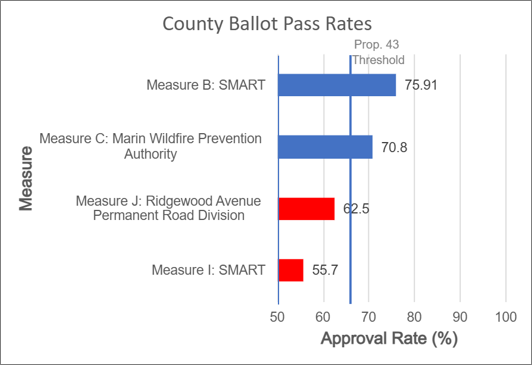
Summary: Proposition 43 increases the voter approval requirement for certain local special taxes proposed through the voter initiative process. Under current law, local taxes dedicated to a specific purpose, known as special taxes, generally require approval from a simple majority of voters. Beginning January 1, 2027, Proposition 43 would require any new, increased, or extended local special tax proposed by voters to receive approval from at least two-thirds of voters before taking effect. The measure would align voter-proposed special taxes with the existing approval threshold generally applied to special taxes proposed by local governments.
According to the LAO, Proposition 43 could reduce future local government tax revenues by making it more difficult for certain special taxes to be approved. The actual fiscal impact is unknown and would depend on future decisions by local governments and voters regarding whether to propose, approve, or reject special tax measures.
| Supporters | Opponents |
|---|---|
|
|
OCE Analysis: The Board's 2026 Legislative Platform consistently advocates for increased investment in transportation infrastructure, flood protection, affordable housing, parks, public health, behavioral health, climate resilience, and other essential public services. Local special taxes are an important funding source for many of these investments. Proposition 43 would increase the voter approval threshold for certain locally proposed special taxes, making it more difficult for communities to secure dedicated local funding. Restricting local revenue options could limit the ability of Marin County and other local jurisdictions to address community priorities identified in the Legislative Platform. Accordingly, an Oppose position is consistent with your Board's support for maintaining local control and flexibility.
Proposition 44: Requires Community Health Clinics Spend 90% of Revenues on Program Services
Recommended position: Oppose
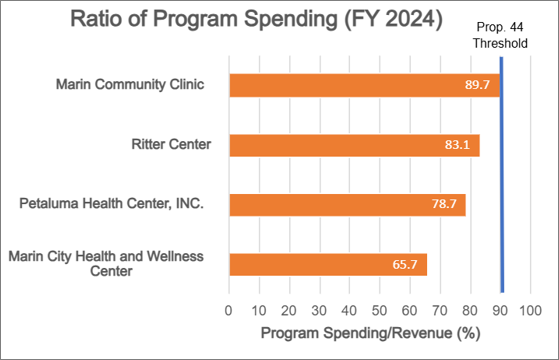
Summary: Proposition 44 establishes minimum health care spending requirements for certain private nonprofit safety net clinics. The measure requires affected clinics to spend at least 90 percent of their annual revenue on providing health care services and limits other expenses, including administrative costs, to no more than 10 percent of revenue. The California Attorney General would establish additional definitions for health care-related and non-health care-related expenses using existing federal reporting requirements as a starting point.
Clinics that are unable to meet the spending requirement under certain circumstances could request a temporary waiver from the state. The measure also creates a penalty for clinics that do not meet the 90 percent spending requirement. The penalty would equal the amount needed for the clinic to reach the required spending level. Clinics could receive a refund if they meet the requirements within five years, otherwise the state would retain the funds for use toward clinical workforce programs.
The LAO estimates Proposition 44 would increase state costs by tens of millions of dollars annually to enforce the requirements, with costs covered through fees charged to affected clinics.
| Supporters | Opponents |
|---|---|
|
|
OCE Analysis: The Board's 2026 Legislative Platform supports preserving and expanding access to affordable, high-quality health care services, strengthening the healthcare workforce, improving behavioral health services, and ensuring adequate state and federal funding for safety-net providers. The Platform also supports policies that improve health equity and access to care for vulnerable populations. Proposition 44 seeks to establish minimum health care spending requirements for certain nonprofit safety-net clinics but does not provide additional funding to expand health care services or increase access to care.
In fiscal year 2024, none of Marin County’s non-profit health clinics met the 90% spending threshold that this proposition would establish, indicating that this legislation would have an impact on the clinics and the communities they serve by requiring greater annual spending on patient services. Aliados Health, the membership organization serving clinics in Marin County impacted by this measure, has joined the official coalition in opposition. Organizations representing clinic have identified a number of essential costs for delivering care, such as those for facilities, maintenance, utilities, or language access, that are not properly accounted for in how the measure considers which expenses are applied toward the 90% threshold for expenditures on health care services. Depending on how the measure is implemented, clinics may be required to reduce or cease operations if they are unable to meet these new fiscal requirements.
Because the measure may undermine priorities in the Legislative Platform while also constraining clinics serving Marin County, an Oppose position is appropriate.
Proposition 45: Modifies Environmental Review for Certain Projects
Recommended position: Oppose
Summary: Proposition 45 amends the California Environmental Quality Act (CEQA) to revise requirements for most housing, transportation, water, utilities, public safety, educational facility, health, and clean energy projects. Project applicants could choose to use the new process instead of existing CEQA procedures.
The measure establishes binding deadlines for state and local agencies to complete environmental review and issue permits, as well as deadlines for courts to resolve CEQA lawsuits. It also changes several aspects of the CEQA review process by requiring agencies to identify all application requirements upfront, evaluating environmental impacts based on the laws in effect when an application is submitted, limiting applicants to one project alternative, restricting tribal consultation to federally recognized tribes, and setting maximum public comment periods.
Proposition 45 also limits judicial remedies in CEQA litigation by narrowing the scope of court review and preventing courts from halting an entire project when only part of the environmental review is found to be deficient. Instead, only the affected portion of a project could be suspended while the agency corrects the deficiency.
According to the Legislative Analyst's Office (LAO), implementation would likely increase state and local government costs by tens of millions of dollars annually during the first several years, potentially exceeding $100 million, as agencies update procedures and comply with accelerated timelines. Over the longer term, the measure could reduce project costs if projects are completed more quickly, but it could also result in greater environmental impacts if projects are approved under the streamlined review process that would not have proceeded under existing CEQA requirements. Impacts on tax revenues are uncertain as they are contingent upon the types of projects that would utilize the new, expedited review process.
| Supporters | Opponents |
|---|---|
|
|
OCE Analysis: The Board's 2026 Legislative Platform supports streamlining permitting and environmental review for projects that advance affordable housing, housing for people experiencing homelessness, transportation infrastructure, broadband deployment, climate resilience, wildfire mitigation, and water infrastructure. While Proposition 45 would establish an expedited CEQA review process for many of these project types, it would also reduce the review requirements and project applicant obligations for uses beyond those identified in the Legislative Platform. Additionally, recent state legislation has significantly modified review requirements for housing projects, the impacts of which have yet to be fully realized.
The Legislative Platform also supports protecting Marin County's natural resources, advancing climate adaptation and environmental stewardship, preserving local land use authority, and respecting tribal consultation and community engagement throughout the planning process. Proposition 45 broadly modifies CEQA procedures by limiting public comment periods, narrowing tribal consultation requirements, restricting agencies' ability to consider new environmental information during project review, and limiting judicial remedies.
Proposition 45 also imposes new requirements on agencies reviewing and permitting projects, shifting obligations that were once held by project applicants to agencies. Despite these increased responsibilities, the measure does not address how agencies would be resourced to incur the costs for adapting existing procedures or the additional ongoing workloads associated. The County’s Community Development Agency staff reported that Proposition 45 would require greater focus on achieving mandatory deadlines, despite County staff still being responsible for producing technically credible and legal defensible analyses.
Because the measure may undermine priorities in the Legislative Platform while also creating new, unfunded obligations for the County, an Oppose position is appropriate.
View the document
This document may not work with all assistive technology and is being remediated. For alternative formats, please email Jake Brymner or phone 415-473-7000. To use the California relay service, dial 711.