

What is a compact mobile food operation (CMFO)?
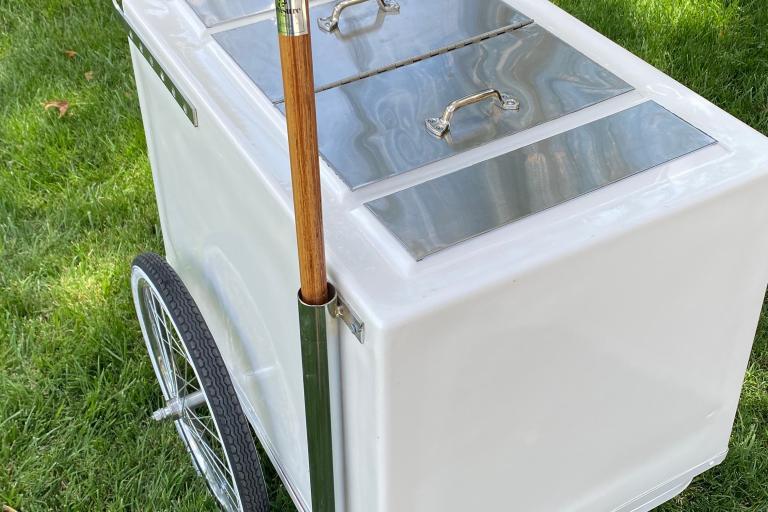
A compact mobile food operation (CMFO) is a non-motorized cart or other type of transport of food that does not have a motor that sells food to the public. A CMFO can sell a variety of food items, but the specific types of food allowed will depend on the CMFO's design and permit. If your cart is motorized it is considered a Mobile Food Facility (MFF).
Are you thinking about starting a compact mobile food operation (CMFO)?
We have some helpful information for you! Our document Compact Mobile Food Operations frequently asked questions will answer many of your questions about operating a non-motorized cart. This document is available in English and Spanish.
Before starting a CMFO
Before starting a compact mobile food operation business, you must contact all the cities where you want to sell your food. Each city may have different rules, so it's important to check with them. You want to make sure that you can legally sell food in the areas where you plan to operate.
Plan approval must be obtained from our office before constructing or remodeling any food truck or cart.
Before purchasing a new or used CMFO
Gather the following essential information:
- Cart condition: Is it new or used?
- Prior permitting: Was the cart previously permitted in Marin County or another California county?
- Documentation: Do you have drawings or plans for the cart?
Having this information ready will expedite the permitting process.
New construction of a CMFO
For a new CMFO, plan approval must be obtained from our office before constructing a CMFO.
- Review the CMFO plan check requirements for structural requirements. This is available in English and Spanish. This document needs to be completed and submitted to our office along with two set of plans and a review fee. Review of plans will be charged at an hourly rate.
- The approval process can take 15 business days or longer.
- Once your plans are approved you can begin construction.
- After your cart is built, submit a compact mobile food operation application with your fee. You will be contacted by our office to schedule an inspection of your CMFO.
- Following a successful inspection, you'll receive approval from EHS and a permit sticker to display on your vehicle.
You cannot begin selling food until you have completed and received a permit from our office.
How to get a permit
- Submit a compact mobile food operation application This application is in English and Spanish. The annual operating permit fee is required when you submit your application to our office.
- The approval process can take 15 business days or longer.
- Once the application is reviewed you will be contacted to schedule an inspection of your CMFO.
- Following a successful inspection, you'll receive approval from EHS and a permit sticker to display on your vehicle. You can start selling food once you have the permit.
What you need to submit with your application
- Complete the application in full and the annual operating permit fee.
- Include a food safety plan detailing how you'll maintain safe food temperatures and clean your equipment and food preparation surfaces.
- Provide a daily sales location schedule.
- Submit a shared food facility/commissary agreement. All mobile food businesses will need a commissary to provide access to clean water, waste disposal, and storage. If your commissary is outside Marin County, the agreement must be signed by the local environmental health office.
Where to submit your application
We accept applications by email or in printed form. Applications cannot be processed without fee payment. You can call the number provided on this page to make payments by Visa or MasterCard.
If you choose to hand deliver your application, please arrive 1 hour before closing to be safe.
Please contact us if you have additional questions or need assistance.
Definitions
What is prepackaged food?
Food that is sealed in a package to protect against contamination. Prepackaged food can be commercially pre-packaged such as bags of chips or can be made and packaged in a permitted food facility. The packaging needs to have a label telling your customers what the contents are, the quantity, and the manufacturer's information.
What is potentially hazardous food?
Potentially hazardous foods are those that require temperature control to prevent bacteria from growing. Examples are: cooked and raw meats, cut tomatoes, tamales, cut melons, cooked rice, cooked potatoes, cooked beans, dairy, etc.
What is a commissary, and do I need one?
Yes, you need a commissary and your application needs to include the commissary agreement. A commissary is a permitted food business that provides you access to their facility for things like clean water, waste disposal, and storage If your commissary is outside Marin County, the agreement must be signed by the local environmental health office.
The commissary is needed to support your business when any of the following occur:
- Food, containers, and supplies are stored.
- Food is prepared.
- Food is prepackaged for sale or display on the food cart.
- Utensils and equipment are cleaned and sanitized.
- Potable water is obtained.
- Liquid and solid wastes are disposed.
- Carts are washed and stored.
- Water tanks are filled, and wastewater tanks are emptied.
Related
-
Compact mobile food operations frequently asked questions
Food service with a pushcart, stand, display, pedal-driven cart, wagon, showcase, or rack.
-
Food program fees
Fee schedule for food program permits and services.
-
Compact mobile food application in English and Spanish
Serving food from a non-motorized cart, stand or rack.
-
Shared food facility commissary agreement
All mobile and temporary food businesses need to submit a shared food commissary agreement.
-
Commissary kitchens in Marin County
List of commissary kitchens in Marin County.